The Evolution of AI in Language Processing: A Journey Through Time (2025)
History of Language modals and their evolution to where we are currently.
In the ever-evolving landscape of artificial intelligence, language processing stands as one of the most challenging and exciting frontiers. Text, being an unstructured form of data, poses unique difficulties for machines to comprehend and interpret effectively. Over the years, researchers have developed various techniques to unlock the potential of text, transforming it from mere sequences of characters into structured information that machines can understand. This journey through time highlights the remarkable advancements in AI for language processing, from basic frequency counting to sophisticated generative models in just 2 - 3 decades.
The Challenge of Unstructured Text Data
Text is a fundamental yet complex data type that poses significant challenges for machine learning (ML) algorithms. Unlike numerical or categorical data, text lacks inherent structure, making it difficult for machines to derive meaning directly. This complexity has driven the need for innovative solutions to convert unstructured text into structured formats, enabling machines to process and understand language effectively.
The first step in this journey to understand text is by breaking it down to its individual elements. The individual elements of words, sub-words or characters are considered as Tokens and the process of splitting sentences into tokens is known as Tokenization.
The Bag of Words Technique: A Simple Approach
One of the earliest methods to tackle this challenge was the Bag of Words (BoW) technique. BoW represents a document by counting the frequency of each word in it, creating a dictionary of unique words.
For instance, consider a simple sentence like "The cat sat on the mat." The BoW model would count how many times each word appears and represent the sentence as a vector based on these counts. While elegant in its simplicity, this method has notable limitations. It fails to capture the semantic meaning or context of words, treating them as independent entities without considering their relationships.
Word2Vec: Capturing Semantics with Embeddings
To address the shortcomings of BoW, Word2Vec emerged as a breakthrough approach. Instead of counting word frequencies, Word2Vec learns the semantic representation of words by training on large datasets like Wikipedia using neural networks. Each word is assigned a vector (embedding) that encodes its meaning. For example, "king" and "queen" might have similar embeddings due to their related meanings.
While Word2Vec improved upon BoW by capturing semantic relationships, it still struggled with context sensitivity. The same word could have different meanings depending on the surrounding words, which Word2Vec does not take into consideration. For example the word 'Apple' can mean the fruit or the company but Word2Vec produces same embedding regardless of the context it's used in. This limitation highlighted the need for more sophisticated models that could understand context.
RNNs and Attention Mechanisms: Context Matters
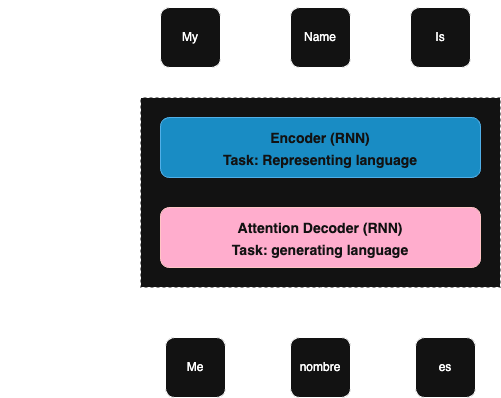
The next leap forward came with Recurrent Neural Networks (RNNs), which process sequential data by maintaining a memory of previous inputs. In language processing, RNNs encode sentences into vector embeddings and decode them for tasks like translation or auto-completion. However, as sentences grew longer, RNNs faced issues with memory loss, failing to retain context from earlier words.
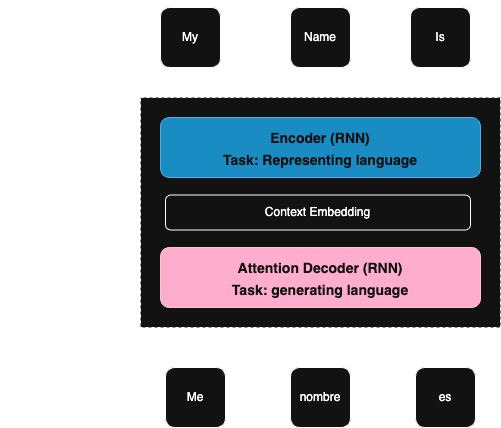
To overcome this, attention mechanisms were introduced in 2014. Attention allows models to focus on relevant parts of the input while generating output, improving accuracy in tasks like translation. This innovation marked a significant step toward more context-aware language processing.
Transformers: Revolutionizing NLP with Self-Attention
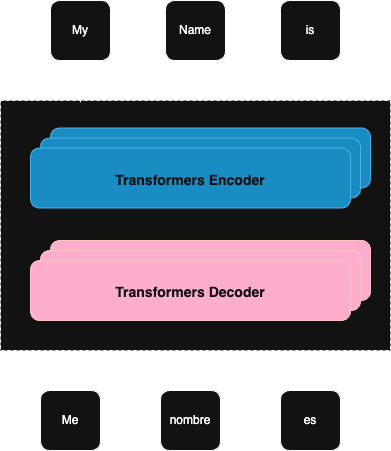
The game-changer arrived in 2017 with the Transformer architecture, introduced in the paper "Attention is All You Need" Transforming both encoder and decoder blocks using attention mechanisms, Transformers eliminated the need for RNNs. Instead of processing one token at a time, self-attention enabled models to consider all tokens simultaneously, capturing intricate relationships between words. Due to this, it became efficient to train on longer forms of text, which gave rise to more sophesticated models that understood the context between text.
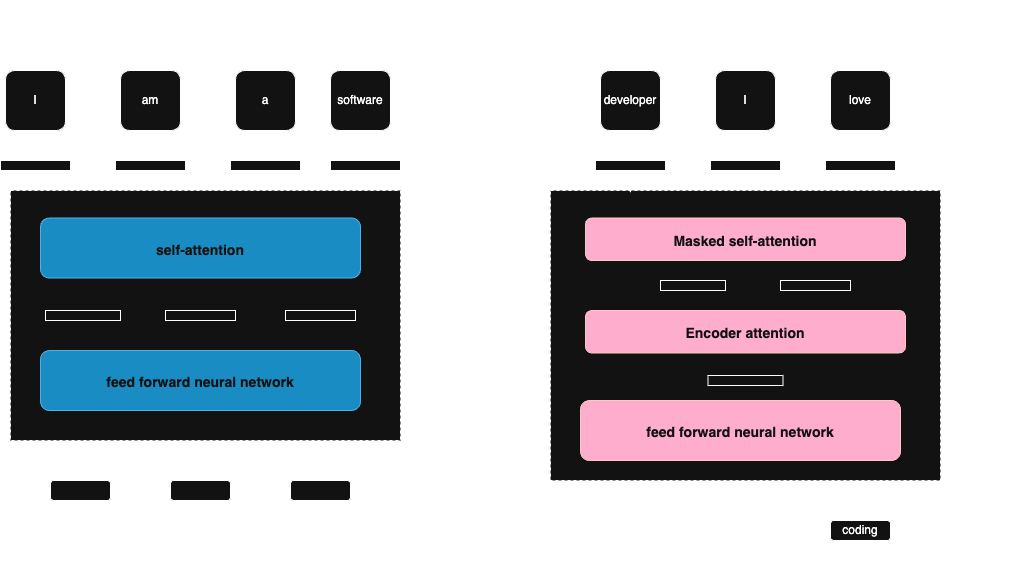
The Transformer's efficiency and power paved the way for models like BERT (Bidirectional Encoder Representations from Transformers), developed by Google in 2018. BERT, an encoder-only model, is used only to represent language in the form of word embeddings. BERT like models uses self-attention to understand bidirectional context, excelling at tasks like classification, question answering and named entity recognition. Fine-tuning BERT for specific tasks has become a powerful approach, requiring less data and computation compared to training from scratch, these class of models are known as Pre-Trained models.
Generative Models: The Rise of GPT
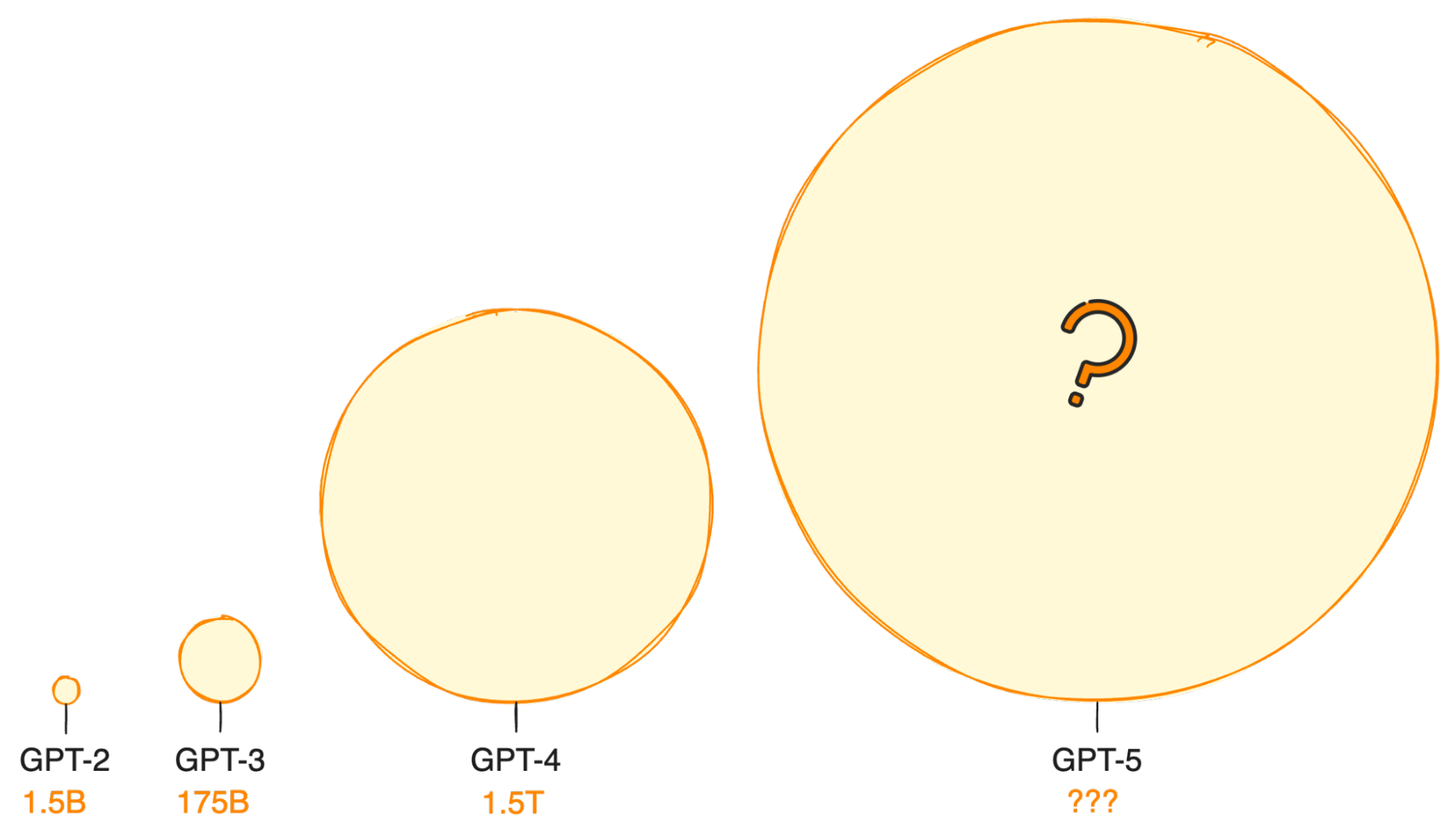
The latest chapter in this journey is the emergence of decoder-only generative models, exemplified by OpenAI's GPT(Generative Pre-trained Transformer). These models generate text by predicting the next word given previous context. Starting with 117 million parameters in GPT-1, the series has scaled up to GPT-4, which boasts a staggering 1.4 trillion parameters and beyond. These class of models are known as Large Language Models
Training these models involves two phases:
- language modeling, where they learn from vast datasets, and are known as foundation models.
- fine-tuning for specific tasks like chatbots or classification.
A important part of these models is the context window or context length, it's the maximum number of tokens that the model can process. The total tokens consist of the input that is fed into the model and the output that the model generates. The longer context window allows for larger documents to be parsed as input to these models.
Conclusion: A Transformative Future
The evolution from BoW to GPT represents a remarkable journey in AI, offering transformative potential across industries. From healthcare to education, these models promise solutions that could revolutionize our world. However, as we unlock this potential, the responsibility lies in ensuring ethical use, as the impact of AI could be both beneficial and dangerous. Example on what ethical use looks like check out Responsible AI
In conclusion, the quest for advanced language processing continues, it's unpredictable on how quickly we acheive creating AGI (Artificial General Intelligence) in our lifetime. If history is indicative of anything, it'll be sooner than we expect. As we stand on the brink of new possibilities, it is crucial to approach these advancements with caution and foresight, striving to harness their power for the greater good and not forgetting the human element of progress.